Modernize your IT with DevOps + AI in 2026 — reliability first, Europe-ready
Enter 2026: The “State of AI” — reliability, control, and production readiness
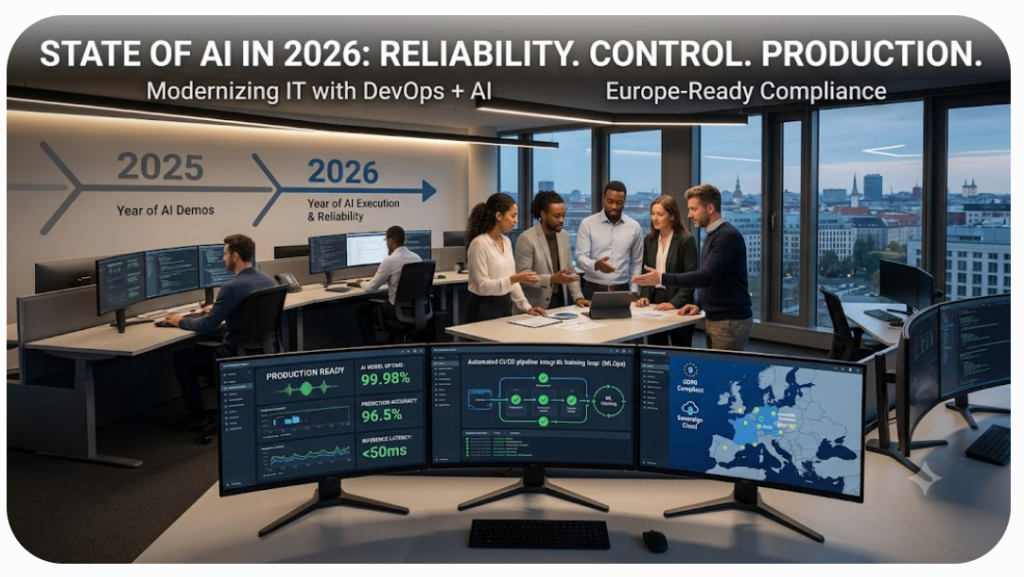
AI in 2026 is about execution. After the 2025 wave of demos and early deployments, the focus shifts to whether AI actually works in day-to-day production—predictably, measurably, and within business and compliance requirements. That’s where most organizations feel pressure: not from model novelty, but from reliability.
AI becomes operational, not experimental
Teams are moving from “trying an AI feature” to running AI as part of real business processes. This changes how IT and engineering teams plan delivery: AI must be versioned, tested, released, monitored, and improved over time—using the same discipline that modern software delivery depends on.
The reliability issues that matter most
In 2026, the common failure modes are becoming central:
- Hallucinations and confidently wrong answers
- Drafts / partial outputs that don’t meet user expectations
- Inconsistent behavior across similar requests
- Unstable performance under real usage patterns
As a result, the biggest investments are shifting toward evaluation, quality checks, and regression testing—so reliability improves after launch, not just before it.
Cost predictability moves to the foreground
When AI becomes part of standard workflows, token usage turns into a business constraint. Organizations are increasingly focused on:
- Managing prompt/workflow efficiency
- Estimating and controlling spend per use case
- Balancing quality and cost with clear policies
In practice, this is becoming a core part of “running AI,” not a side concern.
Agentic workflows expand—oversight has to keep up
More organizations are adopting agent-like patterns where AI systems coordinate steps and tools. The opportunity is faster execution; the risk is reduced visibility when autonomy increases. In 2026, success depends on practical governance: permissions, guardrails, auditing, and controlled rollout of autonomy.
Europe keeps shaping “how” AI is delivered
For European customers, requirements around data handling and where systems run influence architecture decisions. This drives a stronger preference for approaches that keep control, support compliance expectations, and make operational behavior auditable.
Where Achterkamp IT consulting fits in
A strong 2026 “State of AI” strategy connects AI ambitions to an operational model:
- Clear delivery and release control for AI features
- MLOps/LLMOps-style lifecycle management for continuous improvement
- Reliability engineering for evaluation and quality regression prevention
- Monitoring and governance that make AI behavior traceable in production